
String Wound Filter Elements: How Gradient-Density Winding Delivers Deeper Filtration
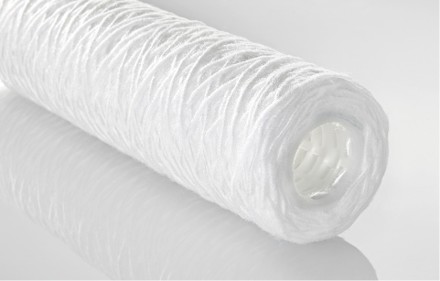
It is the plainest filter in the plant: a yarn cartridge that costs a few dollars and quietly protects equipment worth many times more. A string wound filter element is wound from continuous yarn over a perforated core, and its graded structure — loose outside, tight inside — has kept it the default choice for pre-filtration in water treatment, food processing, electronics and pharmaceutical plants for decades.
What a String Wound Filter Element Is Made Of
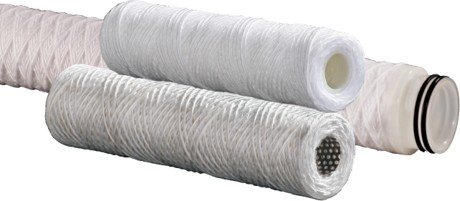
Continuous yarn is wound in a criss-cross pattern around a rigid, perforated core. The yarn may be polypropylene, bleached cotton or glass fiber, while the core is either polypropylene or stainless steel — a choice that follows the fluid, the temperature and the pressure. Standard outside diameters are 63 mm and 115 mm, with 28 mm or 30 mm inside diameters, and elements are supplied in lengths from 9.75 inches up to 50 inches. Ends can be ordered as DOE with or without a gasket, 222 or 226 flat or finned connections, or a self-seal spring, with silicone, EPDM, NBR or Viton seals.
Why Gradient Winding Filters Deeper Than Surface Media
A surface medium stops particles at its face, which is why it blinds quickly. Winding works differently: fibers are applied loosely on the outside and progressively tighter toward the core, so sediment, rust, silt and colloids are captured layer by layer through the whole wall. That is true depth filtration, and it explains the two properties operators value most — high dirt holding capacity and a slow, predictable rise in differential pressure instead of sudden spikes.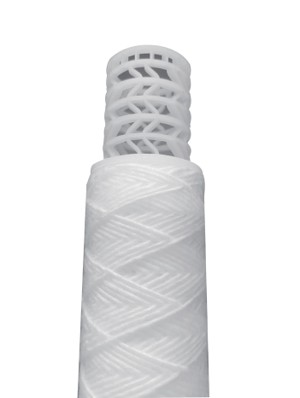
The structure is also strong. Wound under tension around a rigid core, the element tolerates higher differential pressure and harsher operating conditions than many folded media of the same rating, and it resists fiber shedding and leaching in food-grade service.
Choosing the Right Media and Micron Rating
Temperature decides the yarn. Polypropylene is rated to 80 °C, while a cotton string wound filter element handles hot water duties up to 120 °C. Ratings run from 1 µm to 100 µm, so coarse grades such as 50 or 100 µm absorb heavy solids in high-turbidity raw water, groundwater and circulating loops, while 1 to 10 µm grades protect reverse osmosis membranes, ultrafiltration modules, pumps and precision instruments. Maximum operating differential pressure is 2.5 bar at 25 °C, and finer ratings do raise pressure drop at a given flow — which is why the published pressure-drop curves at 20 °C, for both PP and cotton versions, are the right starting point for sizing.
A glass fiber string wound filter element extends the same design into high-temperature service, including boiler feed water and hot process streams where polymer yarns would soften.
Where String Wound Elements Are Used
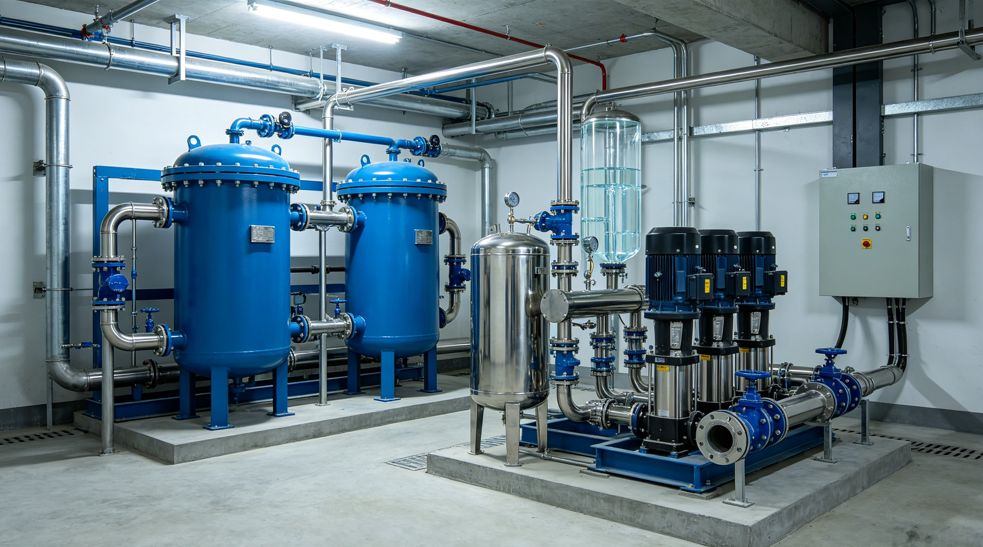
Drinking water remains the largest application: a string wound filter for drinking water removes sediment and rust before chlorination, storage or distribution, and the same elements serve food and beverage lines, cooling water, boiler feed water and chemical pre-filtration.
Electronics fabs and pharmaceutical plants use a string wound filter element for semiconductor rinse water and process water protection, where consistent particle removal upstream safeguards far more expensive downstream stages.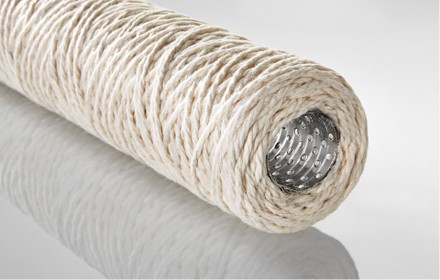
Reading the Ordering Code
Model numbers are short. In HMSW-5-10-PP-1-S, HMSW is the series, then outside diameter (blank for 2.5 inch, BB for 4.5 inch), micron rating, length in inches, and material — PP for polypropylene yarn on a polypropylene core, CS for cotton yarn on stainless steel, CP for cotton on PP, and GS for glass fiber on stainless steel. The final characters define end cap and seal.
Buying String Wound Elements from the Factory
Whether you are comparing wholesale string wound filter cartridges for a municipal plant or specifying a string wound filter cartridge for RO protection, buying from the manufacturer keeps winding density, dimensions and batch quality under one roof. Homay Filter winds its own elements in-house under ISO 9001, and FDA-compliant materials make the same string wound filter for drinking water suitable for food and beverage service. Custom lengths, media, end caps and OEM programs are available.
Send us your flow rate, inlet turbidity and target rating, and we will recommend a string wound filter cartridge for RO or general pre-filtration duty — plus a sample for your own trial. Write to sales@homayfilter.com or visit www.homayfilter.com.