


How to Select Industrial Liquid Filter Bag|Homay Filtration Buying Guide
Filter bags are widely deployed for industrial liquid treatment across water treatment, chemical processing, mechanical manufacturing, food & beverage, pharmaceutical and micro‑electronics sectors. As a cost‑effective consumable, filter bags deliver large dirt‑holding capacity for bulk solid‑liquid separation. Many procurement and process engineers run into frequent bag blinding, unexpected bypass contamination and shortened service cycles, simply by selecting filter bags only according to printed micron numbers, without evaluating full‑scale site conditions. Even the hot selling bag filter cannot bring stable performance if it fails to match your process parameters. That makes systematic filter‑bag selection an essential task for daily fluid‑process operations.
Define your filtration objectives before purchase
Before placing bulk orders, get clear about your real‑world filtration goals. Confirm whether the task is coarse pre‑filtration, general clarification, or critical fine polishing for downstream equipment protection. Different objectives set baseline requirements for retention efficiency, filter media and bag construction.
A common mistake among buyers is choosing the finest available micron rating for every application scenario. Even if lab particle‑capture data looks good, an overly‑fine pore structure leads to rapid clogging, frequent bag replacement and higher long‑term operational costs. Always analyse incoming fluid contaminant features: particle‑size distribution, solid‑particle load, and whether colloidal or gel‑like substances exist in the liquid feed. For heavy‑sediment process streams, adding pre‑filtration stages upstream will effectively extend filter bag service cycles and cut overall running expense.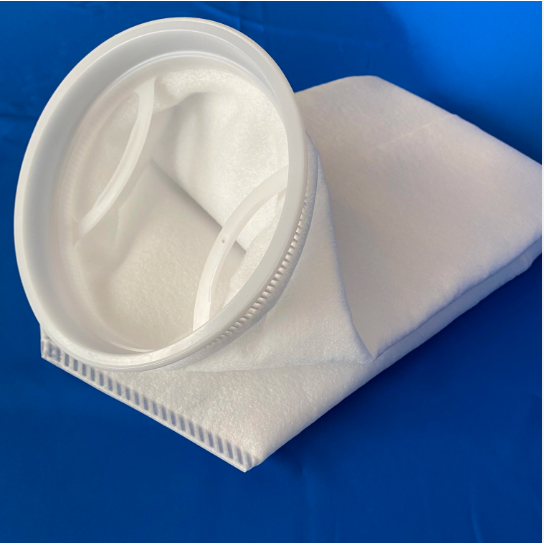
Verify chemical & thermal compatibility of filter media
Material compatibility stands among the most decisive selection criteria. Our standard filter bag media portfolio includes polypropylene (PP), polyethylene terephthalate (PET), nylon and PTFE, each with fixed limits for pH window, maximum operating temperature and solvent resistance.
Polypropylene (PP):Works reliably for most aqueous liquids, dilute acid and dilute alkali environments, maximum operating temperature reaches 80 °C. It delivers solid cost‑performance for general‑purpose industrial filtration.
PET (Polyester):Handles process liquid up to 120 °C, suitable for hot process water, oil and solvent‑based streams.
Nylon:Reaches 160 °C maximum service temperature, features good abrasion resistance for viscous fluid filtration.
PTFE:Suits highly‑aggressive organic solvents and strong corrosive fluids, maximum working temperature up to 200 °C.
Wrong media choice will trigger membrane swelling, fibre shedding or chemical decomposition. The filter bag itself then becomes an internal contamination source for your whole production line. Always cross‑check chemical‑resistance tables against your actual process fluid, rather than only following catalog general statements. Collar material is equally important; available collar options are stainless steel, PP, PET and PTFE to match your fluid chemistry and temperature requirements.
Distinguish nominal micron rating and absolute micron rating
Do not confuse nominal micron rating and absolute micron rating when reviewing specification sheets. Nominal‑rated filter bags offer partial particle retention at labelled particle size, which fits non‑critical bulk removal tasks. Absolute‑rated filter bags guarantee high‑efficiency capture for defined‑size particles, which is mandatory for pharmaceutical liquid processing, micro‑electronics and other high‑purity production lines.
Never fully trust printed numbers on bag labels. Request supplier’s independent test reports for retention‑efficiency verification. Our filter bags cover removal ratings ranging from 1 μm up to 800 μm, both nominal and absolute versions available for customer selection.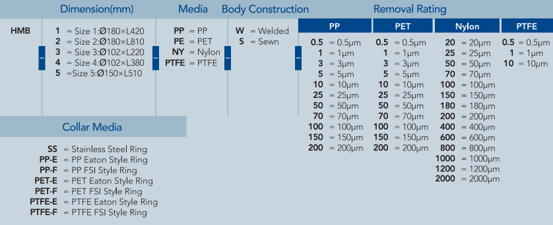
Match bag dimension, collar construction and filter‑housing interface
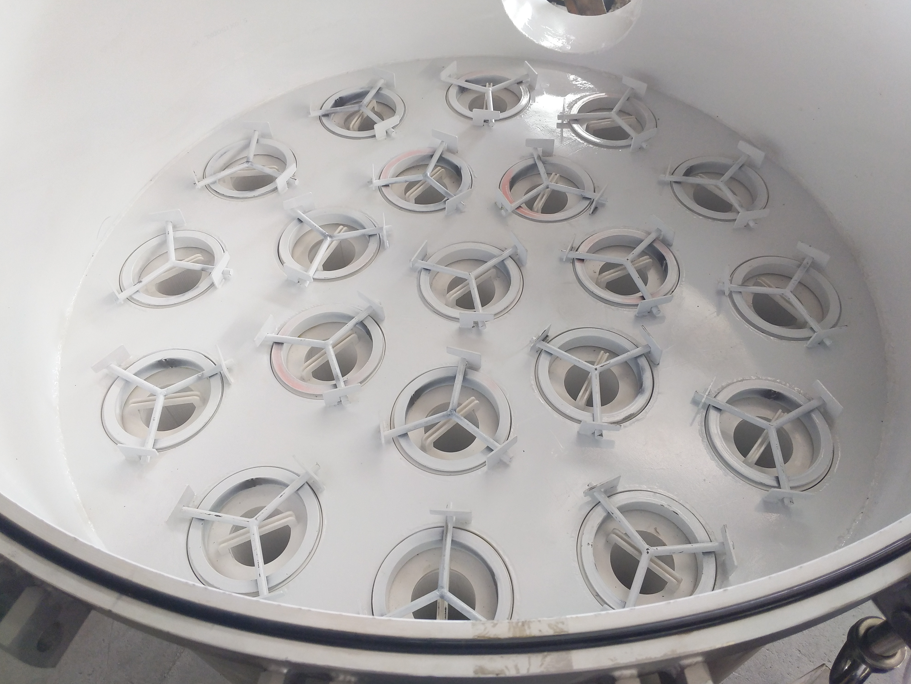
Physical dimension and collar configuration cannot be overlooked during specification. Standard filter‑bag sizes include Size 1 (180 × L420 mm), Size 2 (180 × L810 mm), Size 3 (102 × L220 mm), Size 4 (102 × L380 mm) and Size 5 (150 × L510 mm). Confirm the exact basket dimension inside your existing filter housing to make sure selected bags fit perfectly.
Sewn construction and welded‑seam options are both available. A mismatched collar or poor‑fitting seam will create fluid bypass. In this situation, no matter how good filter‑media performance is, you can never reach expected filtrate cleanliness. When preparing ordering codes, make clear size number, media material, seam style, micron rating and collar material; our sample ordering format: HMB-1-PP-W-10-PP.
Balance system flow rate and allowable differential pressure
System throughput and maximum allowable differential pressure greatly influence filter‑bag service life. Each filter bag has its recommended working flow window. When your process flow rises sharply, evaluate whether you need larger‑size filter bags or multi‑bag housing assembly to distribute liquid load and suppress fast pressure‑rise.
Track real‑time differential pressure across filter housing during production runs. Replace filter bags once pressure difference hits manufacturer‑recommended threshold, do not strictly follow fixed calendar‑based maintenance cycles. For reference, PP and PET filter bags can bear 2.0 bar differential pressure at 20 °C and 1.0 bar at their peak temperature; nylon bags support 2.0 bar @20 °C and 1.0 bar @120 °C; PTFE bags can withstand 2.0 bar @25 °C and 1.0 bar @180 °C. Exceeding pressure limits may cause bag rupture and unplanned production shutdown.
Compliance documents, traceability and on-site sample trial
For regulated industries such as food‑and‑beverage, biopharma and micro‑electronics, certification documents and batch‑to‑batch traceability are necessary purchasing prerequisites. Customers may require food‑contact compliance papers, batch production records and low‑extractables test data for incoming‑goods inspection.
If you are handling brand‑new process conditions or complicated fluid properties, ask your filter supplier for physical samples and run on‑site trial tests before placing large‑volume purchase orders. Real‑site trial helps you observe actual dirt‑holding capacity, pressure‑rise speed, filtrate clarity and any sign of media swelling or seam damage. It effectively prevents costly mass‑order mistakes.
Final practical advice for industrial end users
Even if you go through all theoretical parameters from datasheets and catalogues, remember that lab‑sheet data can never fully replace on‑site verification. Work closely with filtration application engineers and share complete process information: fluid composition, operating temperature, pH value, flow‑rate range, contaminant category, viscosity, and existing filter‑housing dimension. Full‑set condition input allows suppliers to shortlist the most‑suitable filter‑bag models and avoid unexpected production‑line failures.
Properly‑specified filter bags stabilise process‑fluid cleanliness, cut product‑scrap ratio and reduce total‑ownership‑cost for manufacturing plants. Improper selection leads to unplanned downtime, product quality risks and extra maintenance labour cost. Follow this systematic workflow: clarify application targets, confirm media chemical compatibility, validate micron‑rating performance, check physical housing‑fit and carry out field sample trials. This complete workflow will support you to pick well‑matched filter‑bag consumables for your industrial liquid‑filtration processes.