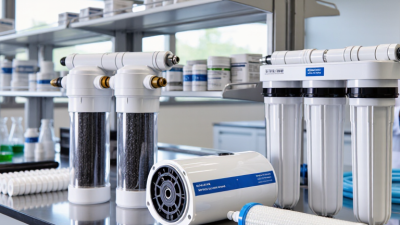
Depth Filtration is one of those go-to methods for clearing up liquids. Basically, instead of just catching everything on the surface like a membrane filter would, it traps particles all throughout its porous structure. That’s why it’s used so widely—it grabs the gunk at different points inside the filter, not just on top. Imagine pouring something cloudy into one of those thick, layered filters. The bigger particles? They tend to hang around near the inlet, while the finer stuff slips deeper before finally getting caught. Honestly, the end result really depends on a bunch of things—the filter medium, how much stuff is in the liquid, how fast it's flowing, and the liquid's properties too.
Filtration is one of those things you don't really think about, but it's everywhere—pharma, food and drink, water treatment, even industrial manufacturing. MarketsandMarkets put out a filtration market report in 2023 and estimated the whole thing at about USD 47.4 billion, with more growth expected through 2028. Now, that number covers a lot more than just depth filters, sure. But it still tells you how crucial filtration tech really is. So, in bioprocessing, you’ll see companies like Sartorius and Pall put depth filtration forward as a clarification step—basically, it knocks down the suspended solids before you get to finer filtration. But that’s just what the guidance says. The real proof? You’ve still got to test it with your actual process fluid and see if it holds up.
David B. Pall was a real filtration pioneer, and his work basically makes the point that you can’t just pick any filter and hope for the best—the design has to match the separation task. Or to put it plainly: a filter only works well when its structure suits the particles and the process. (That’s my paraphrase, not a verified verbatim quote—important distinction.) And yeah, that distinction matters. Depth filters aren’t magic sieves. Loading, pressure, and media choice can all change the outcome. When you really get how particles move through the matrix, it kinda makes sense why the tech works so well—and also where it hits its limits.
What Depth Filtration Is and Where It Is Used
Depth filtration passes liquid through a porous medium that traps particles throughout its thickness, rather than only on its surface. The medium may contain layers with different pore structures. Larger particles are held near the inlet, while smaller ones can be captured deeper inside through interception or adsorption. A Depth Filtration System is useful when a liquid contains particles of varied sizes. That matters.
These filters are used to clarify beverages, process water, and certain chemical or biopharmaceutical liquids. In beverage production, for example, they can reduce haze before further processing. In bioprocessing, they may remove suspended solids from process streams, subject to validated procedures and material compatibility. They are not automatically sterilizing filters. The distinction matters, especially when product safety depends on microbial control.
As particles collect, flow can slow and pressure across the filter can rise. Operators typically monitor pressure, flow, and liquid clarity to decide when to replace the medium.
Not always.
A filter that performs well with one liquid may clog quickly with another, so small-scale trials can reveal practical limits. I would not assume a clearer-looking liquid is always cleaner; the required particle or microbial specification should guide filter selection and testing.
How Depth Filter Media Capture Particles
Depth filter media capture particles throughout a thick, porous structure, not just at the outer surface.
As liquid enters, it follows winding channels between fibers or granules. Larger particles may become trapped near the inlet, where pathways narrow or constrict. Smaller particles can travel farther before meeting a fiber, sticking through surface forces, or lodging in a pore. The Depth Filtration Process therefore depends on more than a single pore-size rating. Media thickness, structure, flow rate, and liquid properties all affect capture. A clear-looking outlet is not proof that every particle has been removed.
Several mechanisms can act at once. Direct interception occurs when a particle follows the flow but brushes a fiber. Inertial effects can push heavier particles off course, while diffusion helps very small particles contact surfaces. Some media also retain particles through adhesion. It can be subtle. During a bench check, a rising pressure drop may indicate that retained material is filling pathways; it does not identify the particle type by itself. Excessive flow can reduce contact time and allow particles to travel deeper into the bed. Media selection should match the target particle range, fluid chemistry, temperature, and operating limits. Real suspensions are messy. Particle shape and clumping can shift performance, so tests under representative conditions matter more than assumptions.
The Main Layers and Materials in a Depth Filter
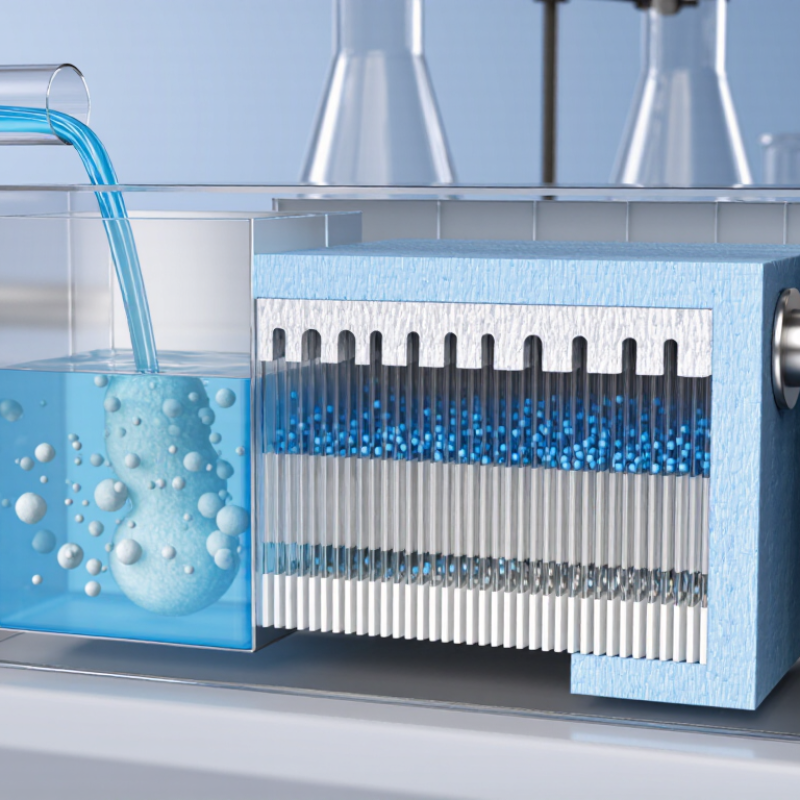
A depth filter contains a porous matrix that captures particles within its thickness, not only on its surface. Its layers often have different pore sizes. Coarser material faces the incoming liquid, while finer material deeper inside retains smaller particles. The exact arrangement depends on the filter’s design and intended use.
Common materials include cellulose fibers, synthetic fibers, and mineral aids such as diatomaceous earth or perlite. Cellulose can form a compact, absorbent web; synthetic fibers may offer greater wet strength. Mineral particles create extra pathways and surfaces where suspended solids can collect. Binders may hold the structure together, so material compatibility matters when filtering sensitive liquids. Small details count.
As liquid passes through, larger particles may lodge near the inlet, while smaller ones travel farther into the matrix. This distributes the particle load and can delay surface clogging. In practice, a rising pressure difference across the filter can signal increasing resistance. It is tempting to treat a layer diagram as the whole story, but real performance also depends on flow rate, particle shape, and liquid properties. A stated pore rating does not guarantee identical retention under every condition. Testing with the actual process liquid is the more reliable check.
How Fluid Moves Through a Depth Filter
Fluid enters a depth filter through an inlet and spreads across a porous, three-dimensional material. Unlike a screen, which mainly catches particles at its surface, this structure gives the liquid many narrow paths to travel. The route is winding, not straight.
As fluid moves through the matrix, suspended particles may be trapped by small openings, intercepted by fibers, or held against internal surfaces. Larger particles are often caught nearer the inlet; finer ones can travel farther before being retained. Not a simple sieve. The exact pattern depends on particle size, fluid properties, filter structure, and flow rate. A diagram may make this look more orderly than it is.
With continued use, captured material builds up inside the filter. Pressure drop across the medium usually increases, and flow may slow if operating conditions remain unchanged. Operators can monitor inlet and outlet pressure, flow rate, and fluid clarity to spot changes. Depth Filtration Technologies use different media designs, so performance should be checked against the process requirements rather than assumed from appearance alone. A practical complication: uneven flow or excessive loading can reduce effective capture, even when the filter looks intact.
What Is Depth Filtration and How Does It Work? - How Fluid Moves Through a Depth Filter
| Filter region or stage |
How the fluid moves |
How particles are captured |
What this means in practice |
| Filter entrance |
Fluid enters the porous medium and divides among connected pathways. |
Particles larger than available openings may be strained at or near the surface. |
Surface straining can occur, but depth filters are designed to retain particles within the medium as well. |
| Coarser upstream region |
Fluid travels through a network of interconnected pores, often along a tortuous path. |
Larger particles can be intercepted or trapped in pore spaces; particles may also contact fibers or other media surfaces. |
In a graded-depth design, this region can retain larger material while leaving smaller particles to travel farther into the filter. |
| Interior of the medium |
Flow repeatedly changes direction as it passes through the porous structure. |
Interception, inertial impaction, and surface interactions can capture particles that do not simply exceed a pore opening. |
Retention occurs throughout the filter’s thickness, which distinguishes depth filtration from filtration that relies mainly on a surface barrier. |
| Finer downstream region |
Fluid continues through smaller or more closely arranged pathways when the medium has a graded structure. |
Remaining particles can be captured by tighter constrictions or by contact with the internal media surfaces. |
Graded structures can distribute particle loading through the medium; not every depth filter has the same pore gradient. |
| Filter outlet |
Filtered fluid exits the medium after traversing its available flow paths. |
Particles retained upstream or within the medium do not normally pass through with the fluid. |
Removal performance depends on the filter construction, particle characteristics, fluid, and operating conditions. |
| As particles accumulate |
Deposits reduce available flow paths and increase resistance to fluid movement. |
Previously captured particles can form additional layers or obstruct pores. |
Pressure drop generally rises as a filter loads; the appropriate change-out point depends on the process and filter specifications. |
Note: Depth filtration describes where particles are retained within a porous medium. Exact retention performance and pressure-drop behavior vary with the filter medium, fluid properties, particle load, and operating conditions.
Factors That Affect Filtration Performance
Depth filtration performance depends on the media, water quality, and operating conditions. In a granular bed, particles are captured at different depths through straining, interception, and attachment. A broad particle-size range can load the bed unevenly. Fine particles may pass through; larger ones can clog the upper layer. Small shifts matter.
Flow rate changes contact time and pressure loss. Faster flow can push particles deeper or through the media, while accumulated solids raise resistance. Temperature matters too: colder water is more viscous, which can alter flow and capture. pH and ionic strength affect how particles interact with media surfaces. In practice, a sudden rise in outlet turbidity may reflect several factors, not just exhausted media. Check flow, pressure drop, and influent conditions together.
Benchmarks help put results in context. The U.S. EPA Surface Water Treatment Rules require conventional and direct filtration systems to keep filtered-water turbidity at or below 0.3 NTU in at least 95% of monthly measurements, with no measurement above 1 NTU. WHO’s Guidelines for Drinking-water Quality also recommend turbidity below 1 NTU to support effective disinfection. These are treatment benchmarks, not guarantees for every process. Depth, media grading, and sampling methods still matter. A clean-looking sample can be misleading. Regular trend review is more useful than relying on one reading.
Common Applications and Limitations of Depth Filtration
Depth filtration is common in water treatment, beverage clarification, and process-fluid preparation. It traps particles throughout a porous medium, rather than only at its surface. This makes it useful when a liquid contains particles of different sizes. In practice, an operator may see a cloudy feed become visibly clearer as it passes through layered media. Cuno Depth Filters is a search term associated with this filtration category. Selection should still depend on the fluid, particle load, and required flow rate, not a phrase alone.
Depth filters can handle substantial solids, but their capacity is finite. As pores fill, pressure drop rises and flow may slow. Very fine particles can pass through, especially if the medium is poorly matched to the feed. Channeling can also occur when liquid finds an easier path through the filter. That is easy to miss. Monitoring pressure and checking filtrate quality helps identify problems, though neither measure tells the whole story. A clear-looking outlet does not prove that every unwanted particle has been removed. Compatibility testing matters too, since some media may interact with particular fluids. Real-world performance can differ from a neat specification sheet.
What Is Depth Filtration and How Does It Work?
Depth filters trap particles throughout a porous filter medium rather than only at its surface. Particle sizes below are representative examples—not guaranteed removal ratings.
Depth filtration is commonly used for liquid clarification and as a prefilter to reduce suspended particles. Its limitations depend on the filter medium, flow rate, and particle load; it does not reliably remove dissolved substances, and removal of microorganisms requires a validated process.
Parker-Replacement Pleated Filter Cartridges: Insights from Grand View Research’s Industrial Filtration Market Report
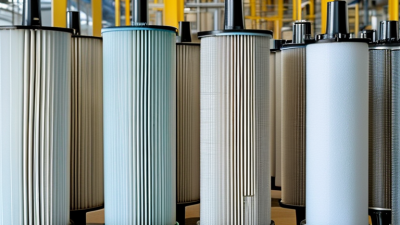
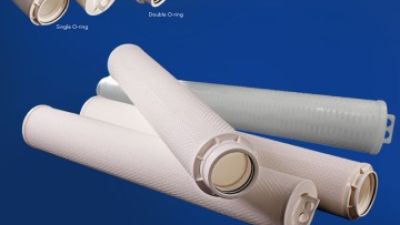
Industrial filtration market analysis points to growing demand for dependable, high-capacity solutions that can support continuous processing while helping facilities manage operating costs. Pleated filter cartridges address these needs by providing a large filtration area in a compact form, balancing strong flow performance with consistent particle capture. For systems designed around high-flow elements, a compatible replacement cartridge can help maintain established filtration setups without requiring extensive changes to the housing or installation process.
Our high-flow pleated filter cartridge is designed as a direct interchangeable replacement for commonly used high-flow elements. Advanced pleated media supports efficient fluid movement and precise filtration, while a practical structural design allows compatibility with many mainstream universal high-flow filter housings. Manufactured in China, the cartridge offers industrial facilities a cost-conscious option for large-volume applications. As suppliers, we can provide flexible filtration solutions suited to different operating requirements, helping customers select an appropriate configuration for their equipment and process conditions.
FAQS
Liquid travels through winding paths in a thick, porous medium. Particles can lodge in pores or stick to internal fibers. Not just the surface.
Larger particles are often trapped near the inlet. Smaller ones may travel farther before contacting fibers or becoming lodged. The pattern varies.
Media structure, thickness, flow rate, fluid properties, and particle shape all matter. Clumping can change results. Real suspensions are messy.
A rising pressure drop can indicate captured material is filling pathways. Flow may slow, too. Pressure alone does not identify the particles.
No. Very fine particles may pass through, and appearance cannot confirm complete removal. I may be oversimplifying, but clarity is only one clue.
Channeling happens when liquid takes an easier route through the medium. Some areas may then capture fewer particles. It can be hard to spot.
It is used in water treatment, beverage clarification, and process-fluid preparation. For example, layered media can make cloudy feed look clearer.
Match the medium to the target particles, fluid chemistry, temperature, and required flow rate. Test with representative conditions. Specifications can miss real-world quirks.
Conclusion
Depth Filtration is a method of removing particles by passing fluid through a thick, porous medium. Rather than trapping contaminants only on the surface, the filter captures them throughout its depth. As fluid travels through a network of interconnected pores, particles are retained by mechanisms such as interception, adsorption, and physical entrapment. Depth filters may contain multiple layers with different pore structures or materials, allowing larger particles to be caught near the inlet while smaller ones are captured farther inside.
Filtration performance depends on factors including the media’s structure, fluid flow rate, particle size, and the amount of suspended material. These filters are used in processes that need to clarify fluids or reduce particle loads, but they have limitations: they can become clogged as particles accumulate, and their effectiveness depends on choosing suitable media and operating conditions. Understanding their structure and how fluid moves through them helps explain where depth filtration is useful and where another filtration method may be more appropriate.